01. TL;DR
I asked people to explain something they had recently learned through ChatGPT. Their responses revealed a common gap: finding information was easy, but connecting and remembering it was harder. Curo explores how AI can turn those scattered answers into a structured learning journey.
ROLE
Product Designer (Me)
TEAM
SOLO
TIMEFRAME
4 Weeks
02. PROBLEM
Thinking beyond the interface.
AI made finding answers easy. The harder part was turning those answers into a clear understanding of a topic.
As research grew, information became scattered across conversations and sources, making it harder to connect ideas and know what to explore next.
How might we turn AI research into a connected learning experience?
03. SOLUTION
Shaping the Experience
Start with a Question
Begin with a familiar action instead of learning how to use the tool.
Why
Starting research can feel unclear. The interface keeps the first step simple while showing what Curo is doing as it researches .
Your Context Matters
Add PDFs, images, or existing material to make research more relevant.
Why
Make research more relevant by letting users start with what they already have.
Control the Depth
Choose how deeply Curo researches and explains a topic.
Why
Not every question needs the same level of detail. Users should be able to control depth without learning how to write complex prompts.
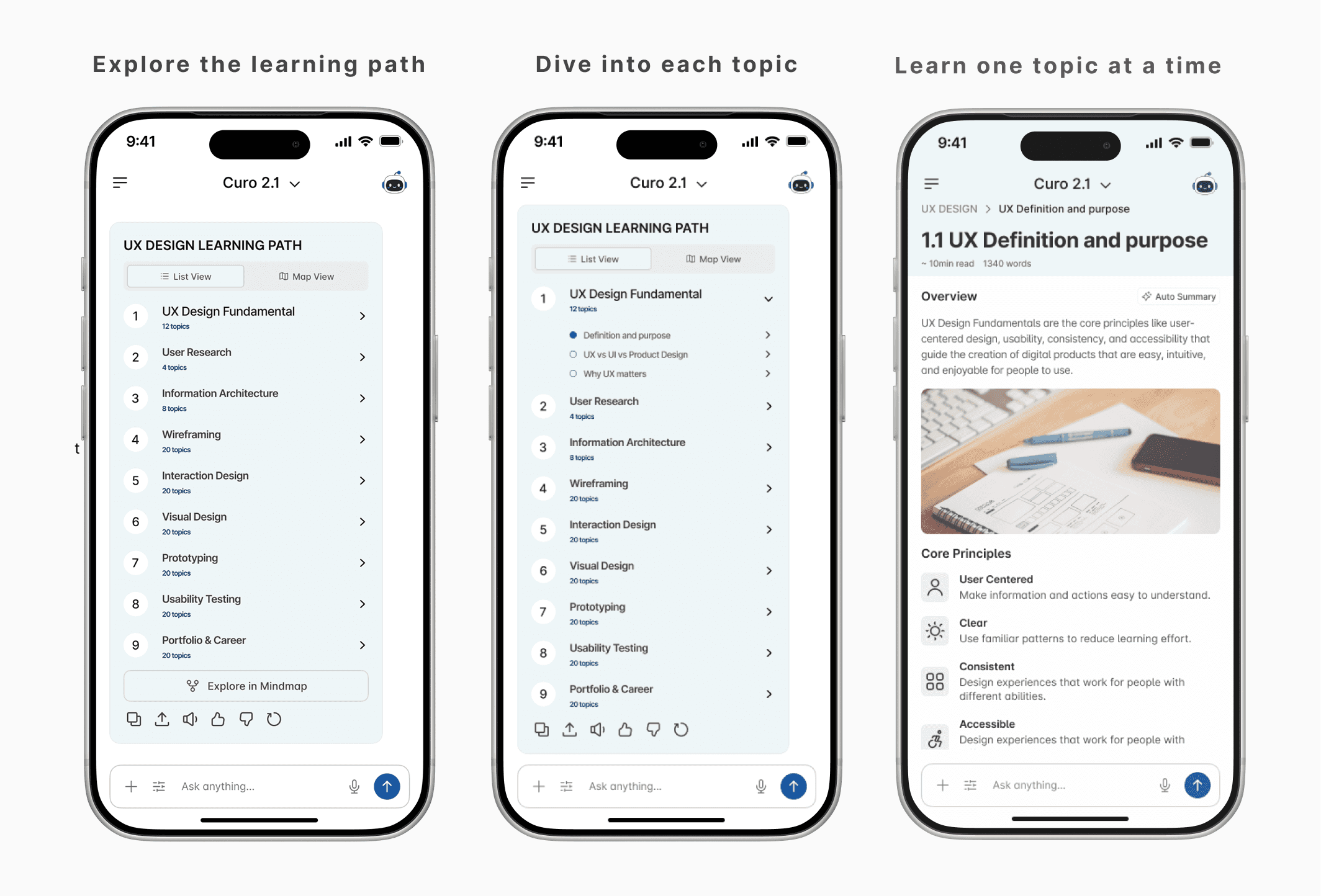
Turn Research into a Learning Path
Turn research into focused modules and smaller concepts.
Why
Transform an AI response into a structured roadmap of modules and smaller topics.
Turn Research into a Mindmap
See how concepts connect and explore beyond a linear path.
Why
Lists are useful for knowing what comes next, but they don't always show how ideas relate. The map gives users another way to understand the structure of a subject.
04. USER RESEARCH
What Users Struggled With After Getting an Answer
I spoke with 12 people aged 18–34 including colleagues, professors, friends in research, and casual students learning topics out of curiosity. I screened for people who actively use AI tools to learn something unfamiliar, not just for quick answers.
I asked them to walk me through the last time they used AI to research a topic. I wasn't listening for frustration with the tool. I was listening for what happened after they got the answer.
A pattern surfaced quickly: the problem wasn't the tool. It was everything that came after it.
Success Metrics
To know if Curo was working, I defined success around three things:
Could users move from a question to a structured learning path without needing instructions?
Did users feel the modules reflected how they actually think about a topic?
After testing, did users say they felt more in control of their learning than with a standard AI chat?
I tested with 12 participants with my figma prototype . 10 of them completed the core flow without prompting. The biggest drop-off was at the mindmap screen but i later fixed with the better mindmap design ( i have mentioned the fix is mentioned in design exploration below this section )
05. DESIGN EXPLORATION
Exploring How Research Could Become a Learning Journey
Before settling on the final experience, I explored different ways AI could support learning. Each concept answered the same question differently:
Challenge
AI answered questions, but not learning goals.
Most AI tools are built for conversations. They provide useful answers but leave users responsible for organizing information, deciding what to learn next, and connecting ideas over time.
Learning became fragmented.
As users explored a topic, information spread across multiple prompts, conversations, and tabs. Revisiting or building on previous knowledge became increasingly difficult.
Solution
Designing a Learning-First AI Experience
Instead of optimizing for better answers, I focused on designing an experience that helps users build understanding over time.
Every interaction was designed around one question:
"What should help the user after they get the answer?"
Finding a simpler way to move from a question to meaningful research.
I explored how Curo could make the beginning of research feel familiar without making users figure out how to use the tool first. The flow starts with a question, adds context when needed, and gradually turns the research into a structured learning path.

Finding a clearer way to turn research into something people can learn from.
I explored how users could move through a topic without feeling overwhelmed by a large amount of information. The experience breaks the research into smaller topics, lets users go deeper when needed, and keeps the overall learning journey connected.
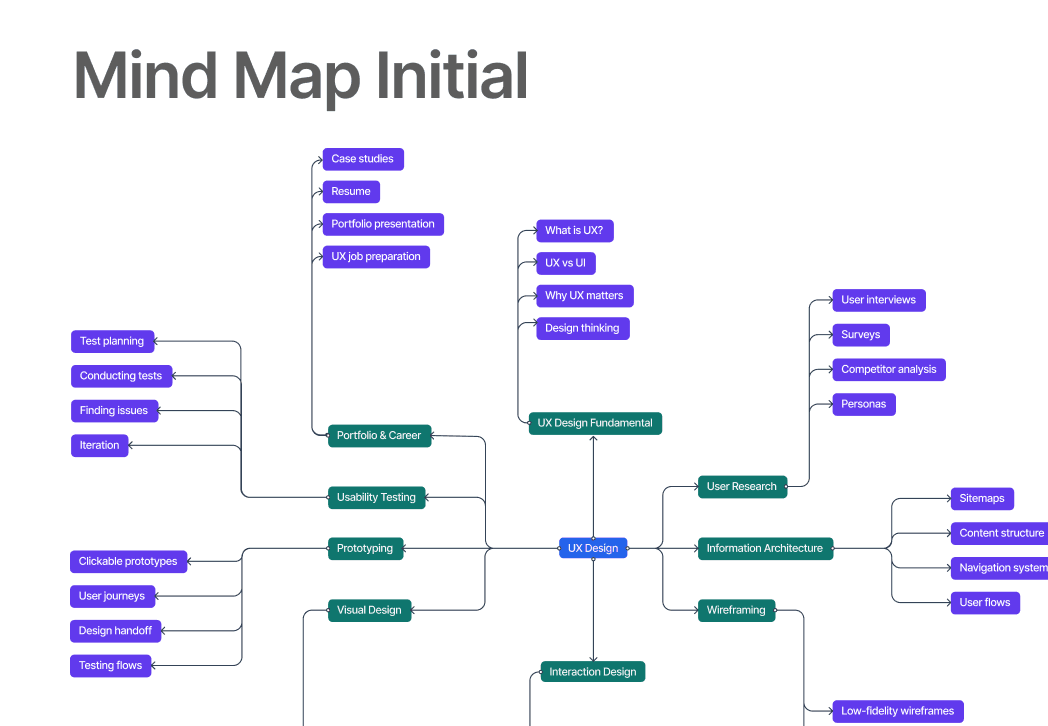
Making the mind map easier to explore on mobile.
My first direction tried to show the whole knowledge structure at once, but it quickly became dense and difficult to scan. I simplified the hierarchy and introduced expandable topic branches so users can see the bigger picture first, then explore deeper when needed.

Slide to see before and after design
06. DESIGN ITERATIONS
Refining the Research-to-Learning Flow
The first direction wasn't solving the problem as well as I thought. Feedback from people familiar with research challenged my assumptions and helped me simplify the experience around how people actually learn.

BEFORE
Dark purple gradient felt unnecessary the structure and content didn't feel the same as the chat screen. It felt like a whole different app.
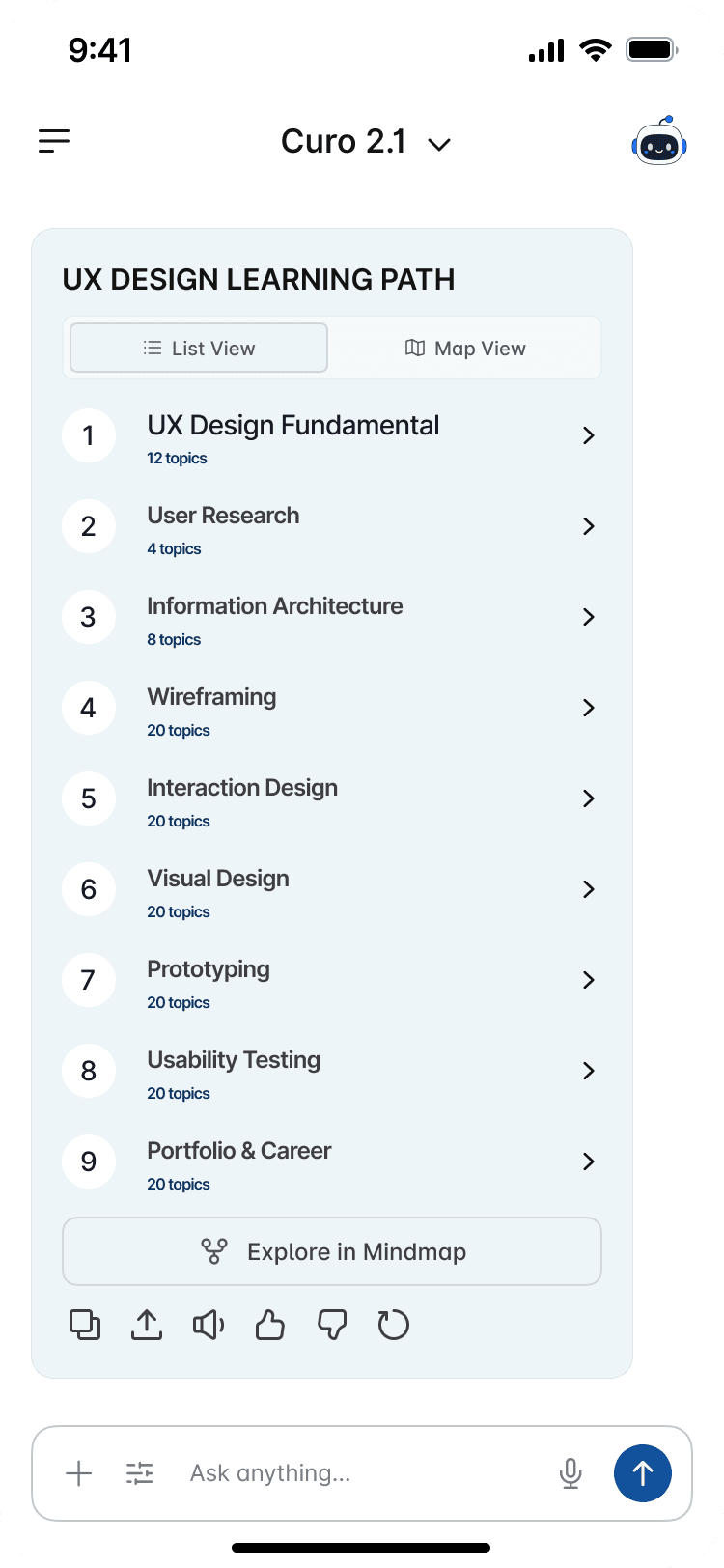
AFTER
I went back to a light blue header that feels like the same family as the chat screen. The list is flat and numbered now just a clear path from 1 to 9 so users always know where I am without looking for a separate bar.

BEFORE
Empty screen felt cold. No personality, no welcome. Just a blank box waiting for input. The send button was a harsh black square. Felt like a form, not a conversation I would make while using.

AFTER
Robot mascot adds a feeling of researching buddy feels like a real greeting. Rounded send button with an arrow feels friendly. The screen invites you to start.
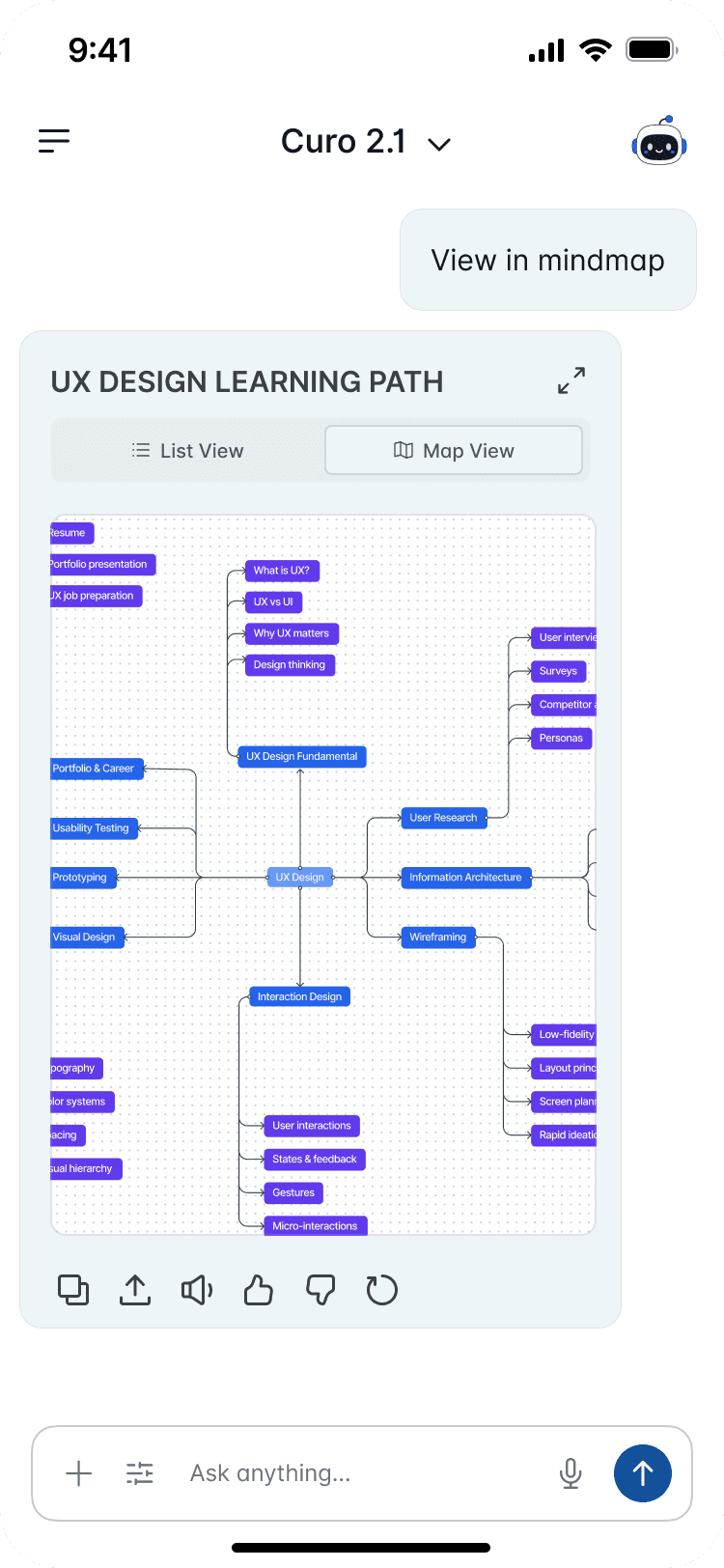
BEFORE
The map showed the topics, but I wasn't sure what should happen when someone reached the end of a branch.

AFTER
I made the final nodes open directly into the lesson, so users can move from exploring a topic to actually learning it.
07. CONCLUSION
Turning Research Into a Connected Learning Experience
Curo started with a simple observation: AI can answer questions, but learning doesn't end with one answer.
The real challenge wasn't building a smarter AI. It was designing what comes after the answer. Structured paths, connected concepts, and a sense of progress are things AI chat alone doesn't give you.
What I'd do differently: I started with people already comfortable with deep learning, which sharpened the problem but narrowed it. Running research earlier with a wider, more casual audience would have pushed the design to work harder for the people who need it most.
Looking Back
Curo started with a simple observation: AI can answer questions, but learning doesn't end with one answer.
I explored how research could become more structured and connected, bringing together learning paths, topic exploration, and Mind Maps to help people build deeper understanding.
Lessons I'll Carry Forward
Better AI experiences aren't only about better answers. They're about helping people understand what to do with them next.
I would probably try to get as many perspective of people using AI for their needs to reduce the scope mid project .